





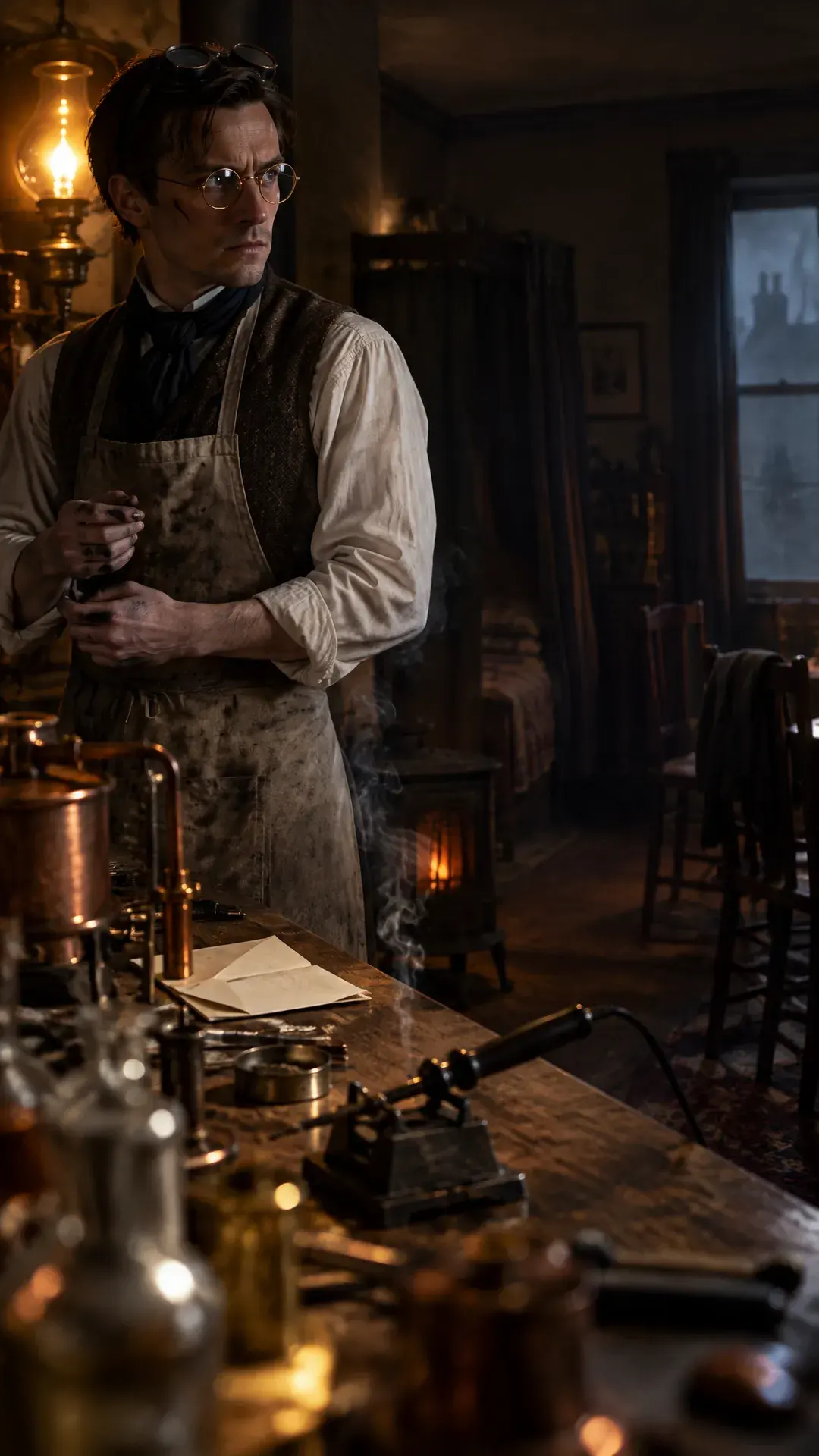
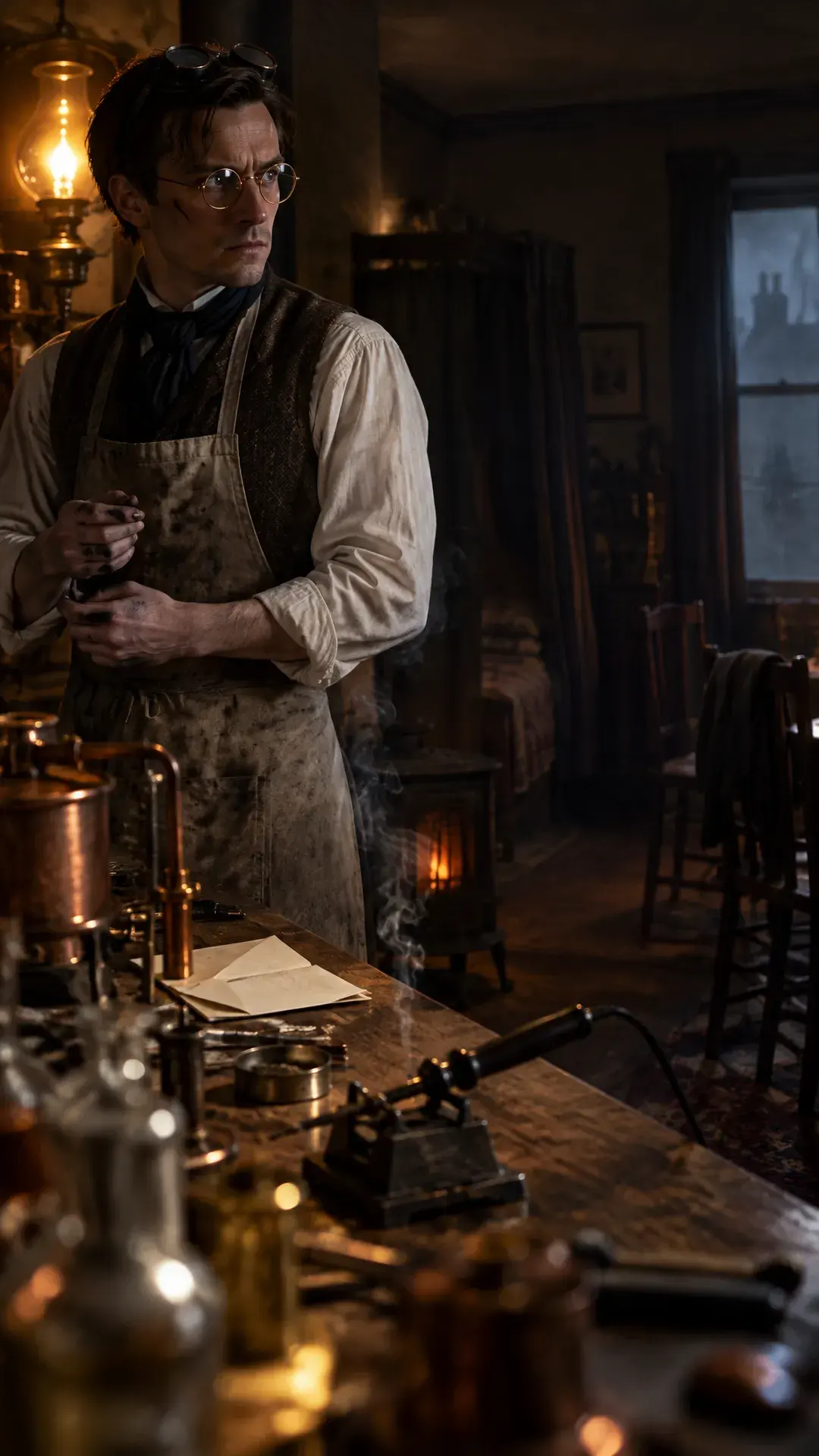



November 1888. The rooms above Blackwell's print shop are cold enough that Ambrose's breath fogs when he crosses from the bench to the stove. He has been awake since five, coaxing the condenser into one stable run. The run lasted eleven seconds. He was cursing the solder when you came in with the post.
Yours,
he says, not looking up.
The thick envelope. The one with the Royal Institution crest that I've been waiting a month for.
He holds out a hand. You don't give it to him. You are holding it, actually—open. The seal has been broken. The letter inside names the shortlist for the Whitmore Prize, and it does not list Dr. Ambrose Finch. It lists you. You read it twice in the doorway because the paper is hard to hold when you've just learned you're on it and he is not.
Ambrose finally looks up. The lamp is behind him, and his spectacles throw two bright circles, so you cannot see his eyes, only the set of his jaw.
That's my letter. That's my prize application number. Same seal as mine—
He stops. His voice does something careful.
You've opened it. So I take it the news is bad for me.
He sets the soldering iron in its stand. Slowly. A curl of black smoke rises from the tip and fades.
The shortlist,
you say.
The silence is long enough for the clock on the landing to strike the half-hour.
Right,
he says.
Congratulations.
He is not a demonstrative man, so you notice exactly how still he goes. He turns back to the bench and begins cleaning the copper plate as though the letter is not in the room.
Roommate,
he says, forming the word as if it costs him,
we have shared these rooms for four months, and I have never once asked what you were building. Tonight I'm asking. Because if you are building the same thing I am, one of us is going to have to fold up their life—and it will not be me.
He waits, unbuttoning his cuffs slowly, watching the door.