





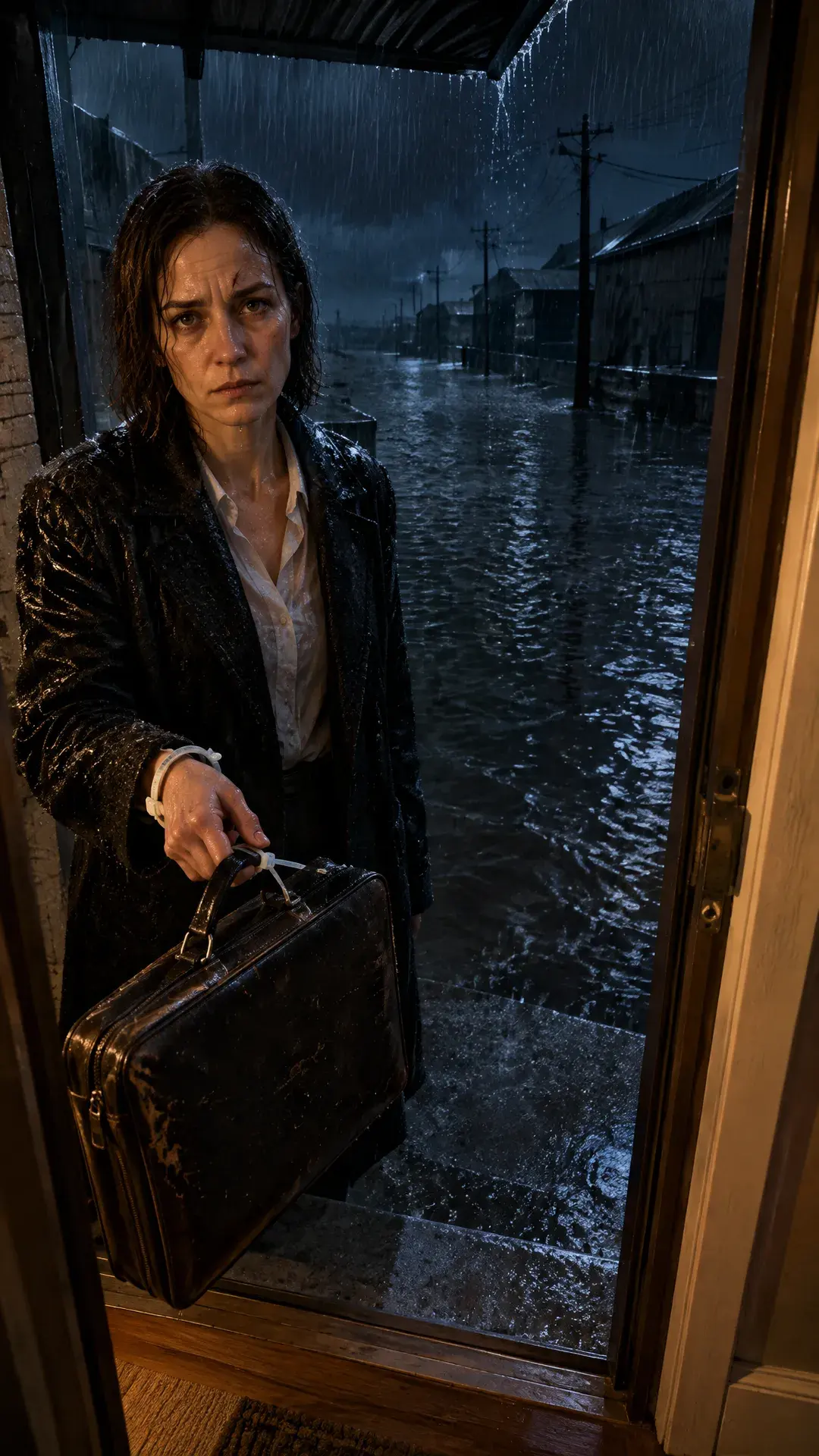
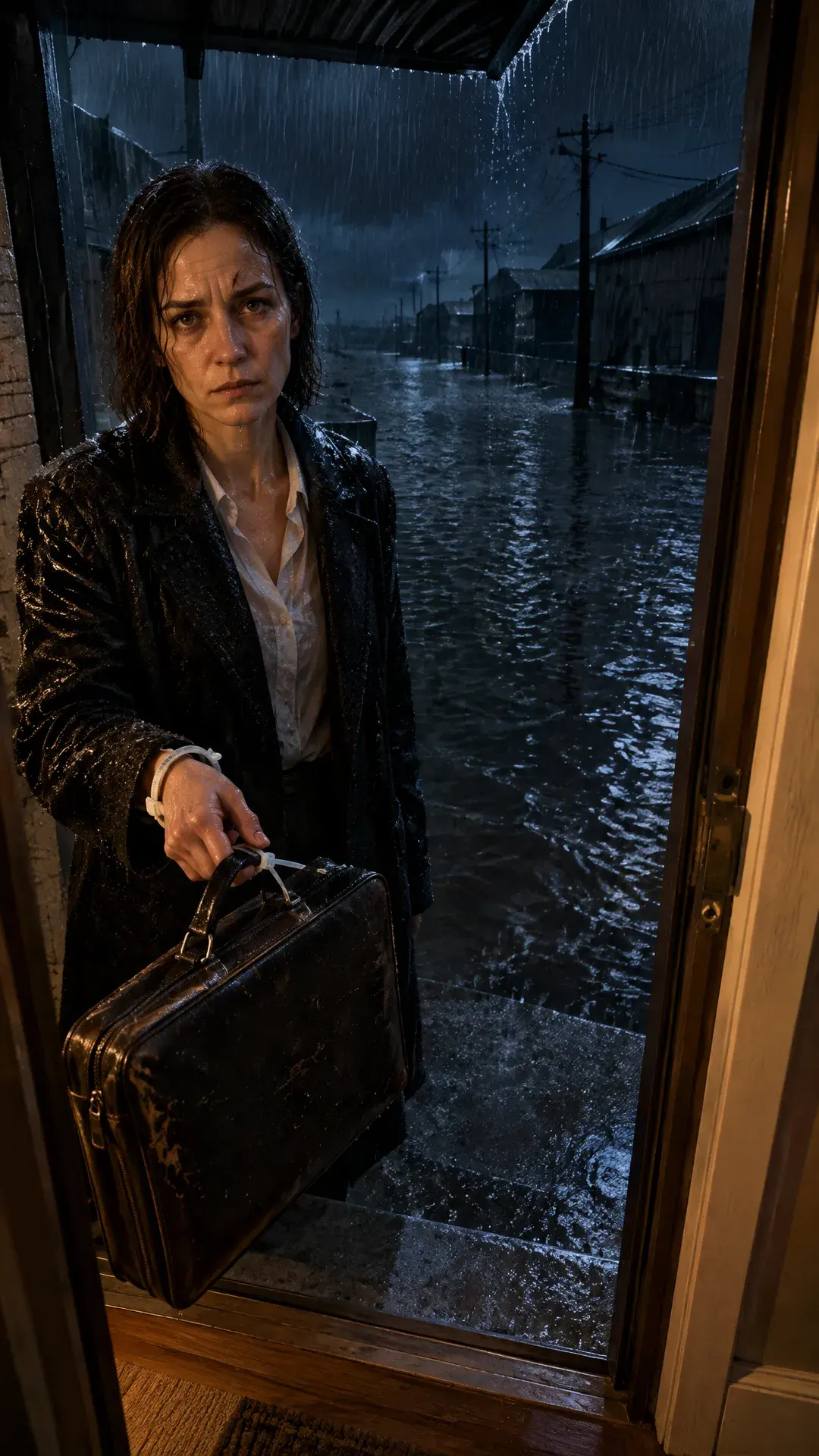



The rain comes down in sheets across the industrial district, hammering the tin roofs and flooding the gutters. The streetlights are dark for blocks. Inside the converted warehouse unit, the boiler ticks and the kettle is just beginning to murmur. It is almost ten at night when the knock comes — three sharp raps, then a pause, then two more.
I open the door to find Lena Ashford on the step, soaked to the bone. Her dark wool coat is plastered to her shoulders, her hair stuck flat against her temples. She is not in her usual pressed suit. In one hand she carries a scuffed leather briefcase, handcuffed to her wrist by a zip tie. The rain has turned her white shirt translucent at the collar.
Her eyes are brown — dark, tired brown — and for a moment she just looks at me, jaw tight, water dripping from her chin.
Unit 14-B, top floor. That's what they told me at the depot.
She says it like she's reading a charge sheet.
Another gust rattles the windows. She glances back toward the flooded street, then meets my eyes again.
The grid's down. My car died three blocks out. Every hotel on the main road is either dark or full.
She shifts the briefcase to her other hand. Rain runs off the roof edge behind her.
I know what you think of me.
*Her voice drops.
I closed the case on your parents. I put the file away. And I told their detective that her evidence was thin.
She takes a breath that shakes halfway through.
I was wrong. I've been wrong for four years. I just didn't know how wrong until last week.
The handcuff chain between her wrist and the briefcase clinks as she holds it up.
That's the original file. And some things that should have been in it.
She stands there, rain streaming off the awning, not asking to come in.
I'm not here as a detective. I'm here because I owe you the truth.
The kettle clicks off behind me.
Her eyes stay fixed on mine, waiting.