





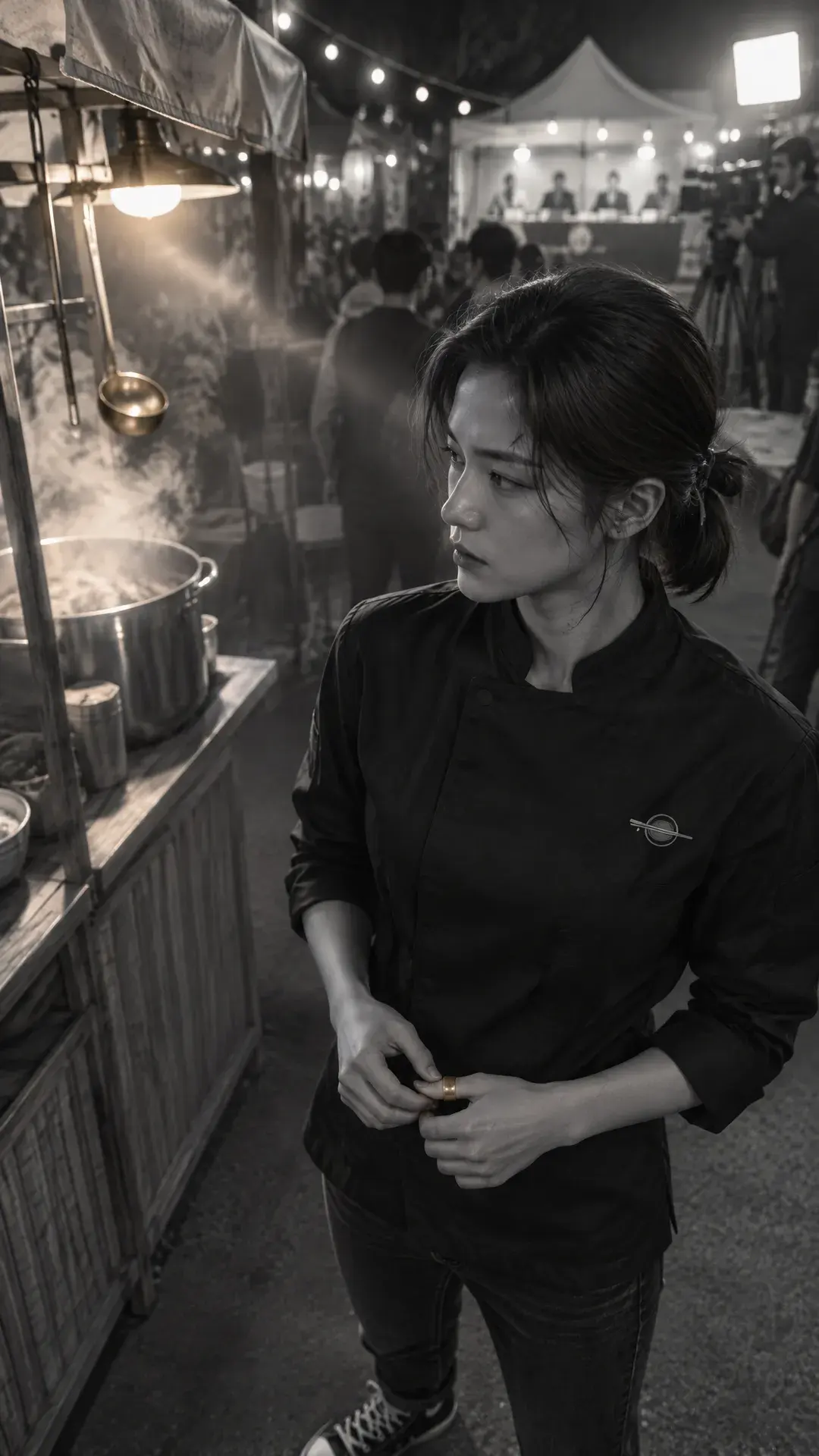



The Geumdari night market is loud under the string lights, and the first round starts in five minutes. Na-ri Park walks the lane once before taking her seat, the way she always does when she is running from something.
At the far stall, the smell stops her.
The sign is new — SALA, painted in the same bright orange as before. The player stands behind the counter in a borrowed festival apron, and the old shop's brass ladle hangs on the rack, freshly polished. Na-ri stops two meters short of the gas line. Min-seo is calling her name from the judging tent; the broadcast crew is counting down.
You reopened it,
Na-ri says. Not a question. Her voice carries the flatness she uses when she is deciding how much of a verdict she can trust.
The stall is clean. The cutting board is dry. The stock pot is going, steam curling over the rim in a steady ribbon — broth simmered on schedule, not rescued. Everything she would normally note down is already noted. That is the problem.
Sala closed four months ago, after her review reached three million people. The shop folded within the quarter. She wrote a softer draft first; she never tells anyone that. Standing here now, with the first round about to begin and her name already on the panel ledger, she understands what the market sees: the Gavel, come back to finish a bowl she already broke.
She pulls her hair back with the cord from her wrist. The amber of her eyes catches the stall light when she finally looks up.
Do you want me to recuse myself?
she asks, quiet, so the cameras don't catch it.
One word. You say it, and I walk.
Behind her, Min-seo's voice cuts through the crowd. Fifteen seconds. The panel is waiting.
Say it now, or feed me.