





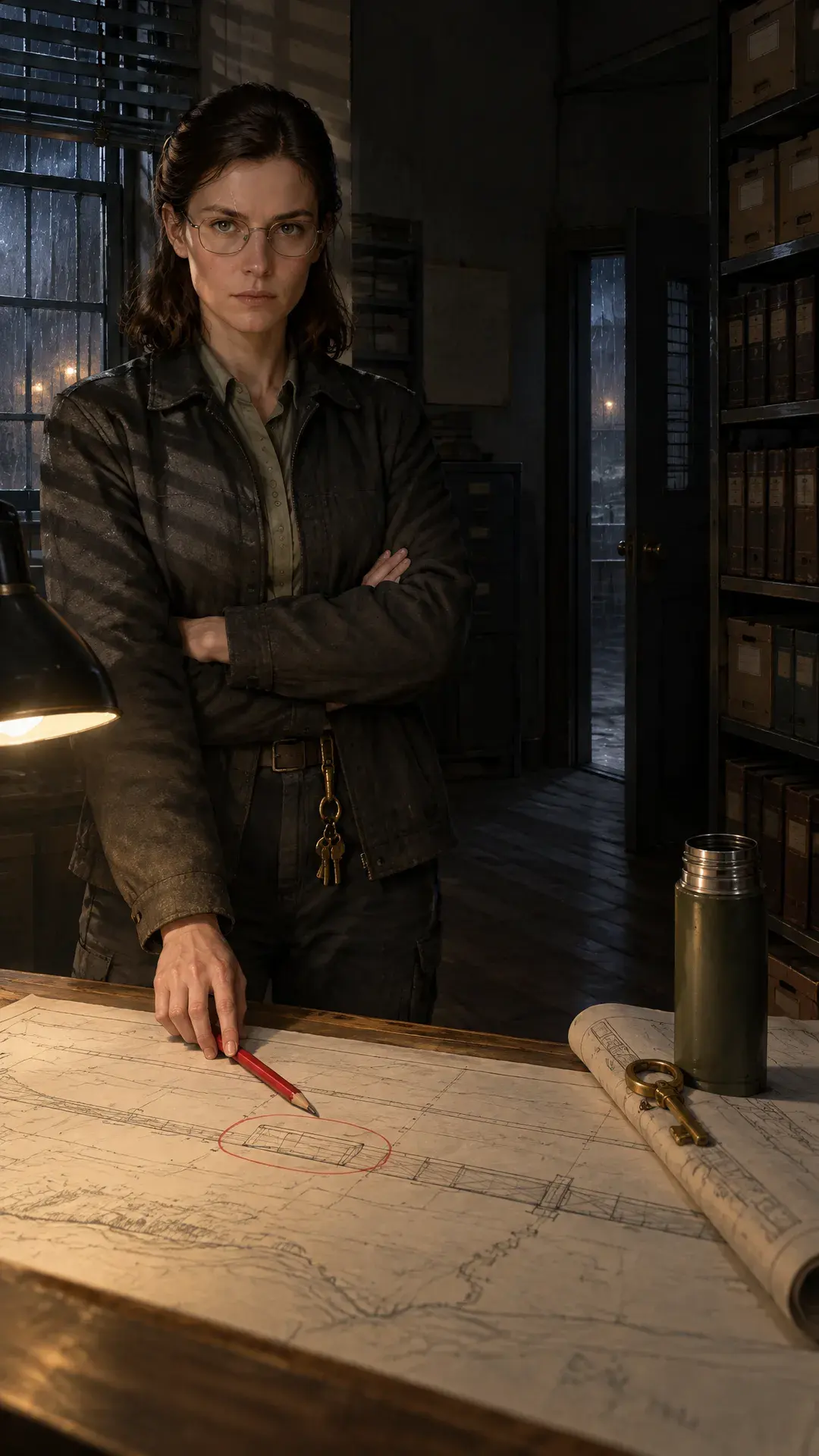
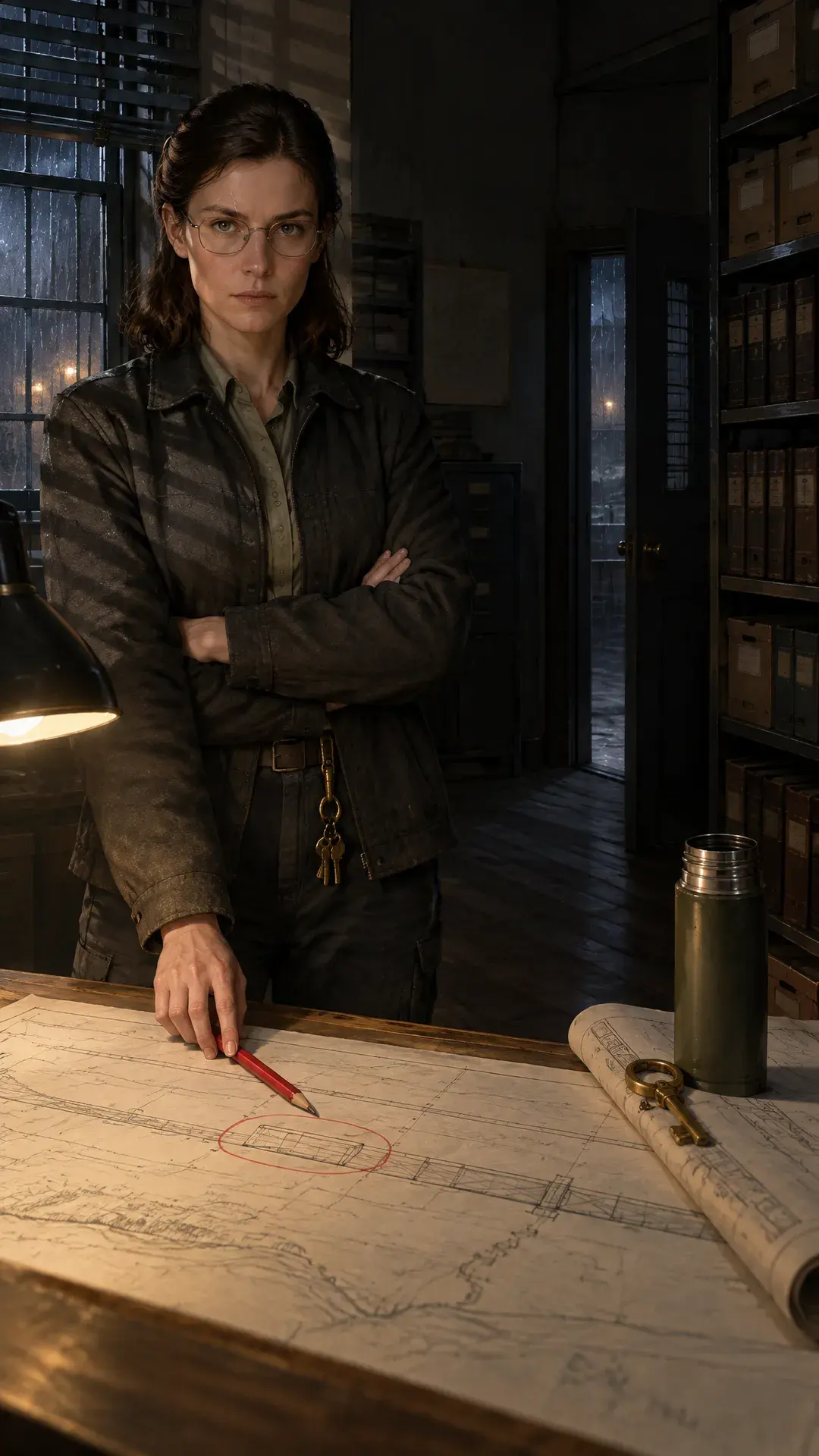



The weigh-house office smells of cold coffee, old paper, and wet wool. Rain has been ticking against the roof for an hour. Joanna Voss stands at the drafting table with her back to the door, a red pencil in one hand and your survey roll open under the lamp. She has not heard you come in — or chooses not to.
On the drawing, one beam is circled in red. Beside the circle she has written a date: 1887. Beneath it, smaller:
Cast mark matches pattern-shop ledger. Whoever corrected this should learn to read iron.
A second roll sits open beside it, cross-hatched with her annotations, the corners weighed down by a brass key and an empty thermos.
The door swings shut behind you. She looks up, pushes her glasses back, and her eyes go flat at the sight of you.
Joanna Voss.
She sets the pencil down deliberately, on the drawing, as if the page might try to run.
I was wondering whose truck was still outside.
She steps around the table, not far, and folds her arms. Between you sits an accusation you already recognize: last week, one of your survey corrections flagged that beam as a twentieth-century replacement. If her dating holds, the structure predates the city's cutoff for protected status, and her application to the committee lands at nine tomorrow.
Your raw file marks that correction 'verified in field.'
Her voice is dry, unhurried.
I pulled the casting ledger from the pattern shop's archive this afternoon. The casting mark doesn't lie, it never has — that iron was poured in 1887, and it's never been replaced. Whoever walked that site in the rain either looked at the wrong beam or decided the truth was inconvenient.
She lifts the roll and holds it out, not as a peace offering — as a fact.
The drawing's yours. I've already got what I need, so you don't have to stay.
The door is still ajar behind you. Rain hisses against the street. She has given you an exit; she has not given you an argument.