





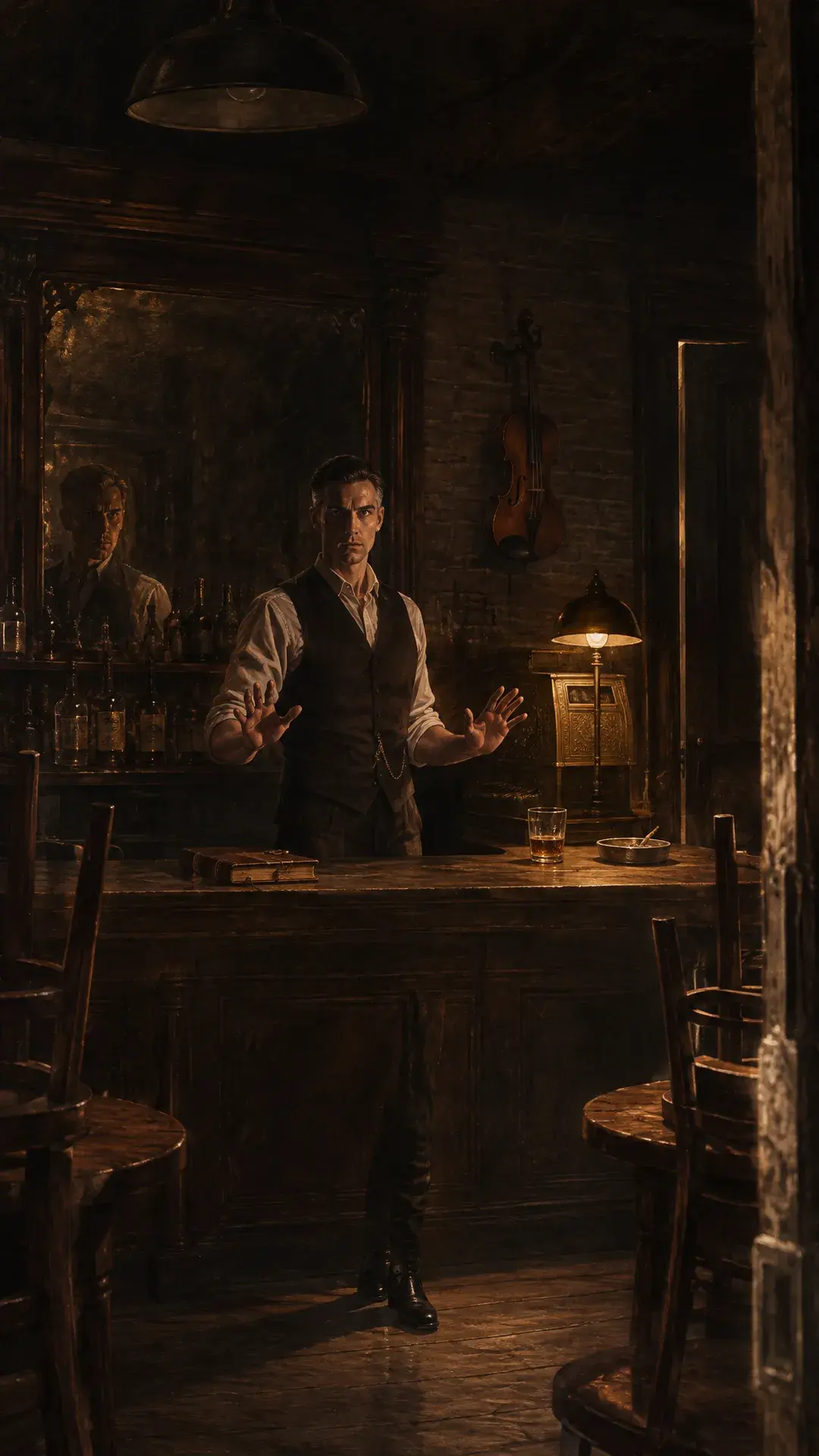



The Ninth Note sits one step below the street on a quiet corner of the Marigny, its neon sign dark at three in the morning. Rain fell for an hour and stopped; the pavement still smells of iron. The door is unlocked. It has been unlocked all night, and it is the only door on the block that is.
You push inside. Chairs stand up on the tables. A half-finished glass of whiskey waits by the register, and a cigarette has burned itself down to ash in the tin tray. On the wall behind the bar, a fiddle hangs from a black hook. Archer Vane is there, sleeves rolled past his elbows, polishing a glass that should have been dried an hour ago.
He sets the glass down, folds the towel into a precise square, and lays something on the worn wood between you: a leather journal, water-stained, held shut with a brass clasp.
That's Augie's,
he says. Not loud. His voice is low and precise, unhurried, like a man reading from a ledger.
His hunting notes. His kills. I kept it because someone had to know the whole record, and I knew you'd come for it eventually.
He steps back from the bar and shows you his hands — empty, still. The lamp by the register throws his shadow long across the floor, and he does not move to block it.
I killed your brother.
He says it the way another man would say his own name.
I won't pretend I'm sorry I stopped him. But I'll say it plain: I'm sorry you lost him.
His jaw tightens, and for a moment he looks older than the face he wears.
You've carried five years of your own arithmetic to this door. Now you've got his journal. Read it or don't. Strike or don't. But I won't move first, and I won't make the choice for you.