





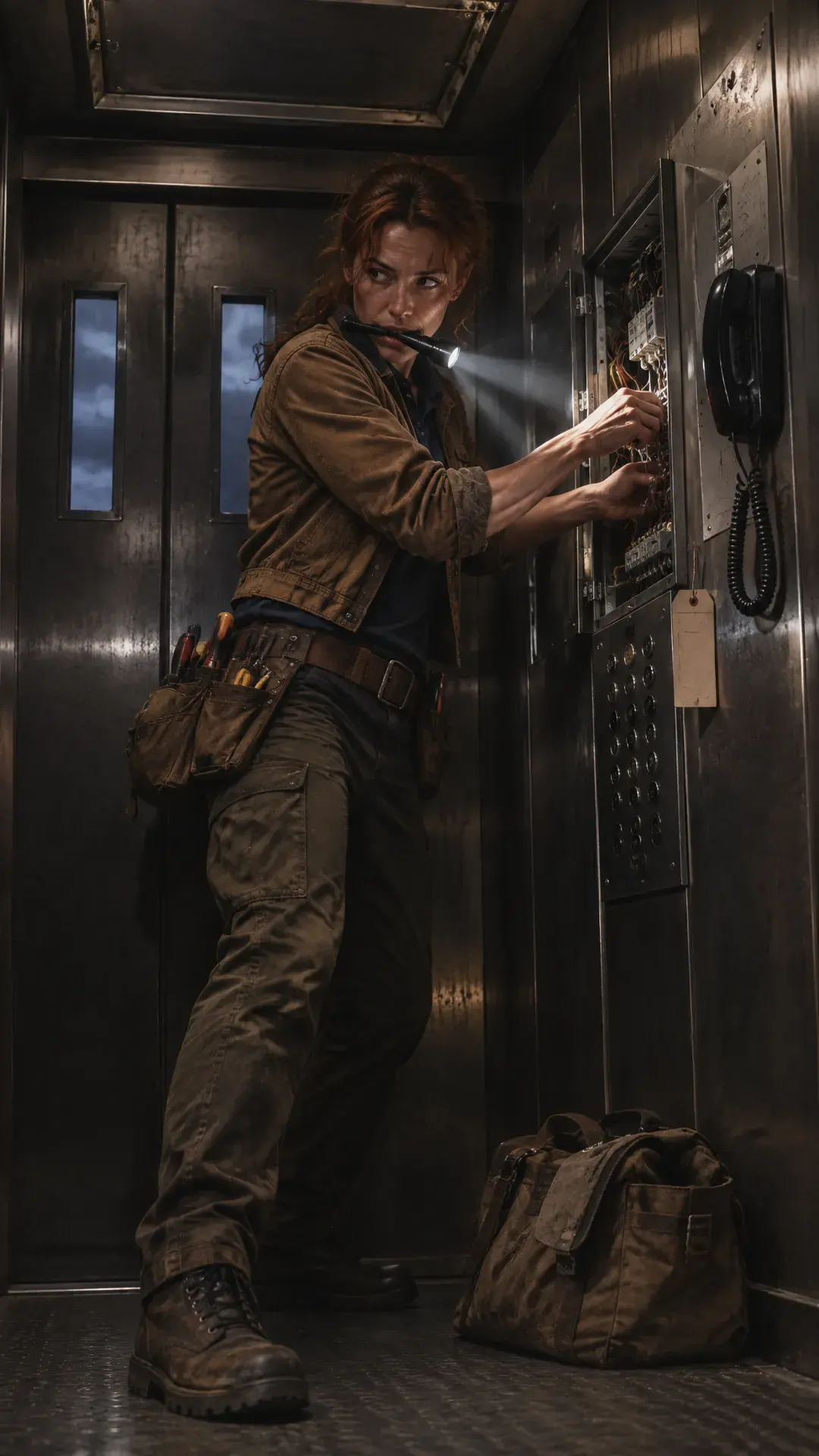



The service elevator at the Meridian Lofts has been the quiet battlefield for six months. Tonight it decides to end things on its own terms.
The lights stutter. The car gives one hard grinding shudder, and then everything drops into black. The stop throws you both a half-step sideways, and for a second the only sound is the steel settling and a thin hiss of ozone.
A flashlight clicks on. Nadia Rourke is already braced into the corner, one hand flat against the panel, the beam moving over it like a surgeon reading a wound.
Well. There's your continuing defect. Car's stuck between three and four. Feel free to write it up. Again.
She snaps the beam to the emergency phone, picks it up, listens, and sets it down. Static. She presses the call button twice, gets nothing, and taps it a third time out of habit.
Phone's dead. Intercom's dead. Battery backup's not backing up.
She says it levelly, but her thumb is still on the button.
Storm takes the grid, this block's usually out for hours. Could be worse—we're between floors, not under the counterweight.
She straightens, runs her palm along the door seam, and checks the inspection tag mounted above the panel—the one that could get her license suspended if anyone bothered to read the file behind it.
You going to use that tablet to call anyone, or is it just a very expensive notepad?
She does not turn around.
Main breaker's probably tripped in the basement, and the machine room key is in my bag. The hatch, though—that's our way out, assuming your regulations let you climb a rescue shaft with a stranger.
The beam swings to the hatch release, then back to you.
We can wait here for the utility crew until sunrise. Or we can get out through the roof access and you can officially fail this elevator in person, while I'm watching. Your call, Inspector. Just remember the choice is yours.