





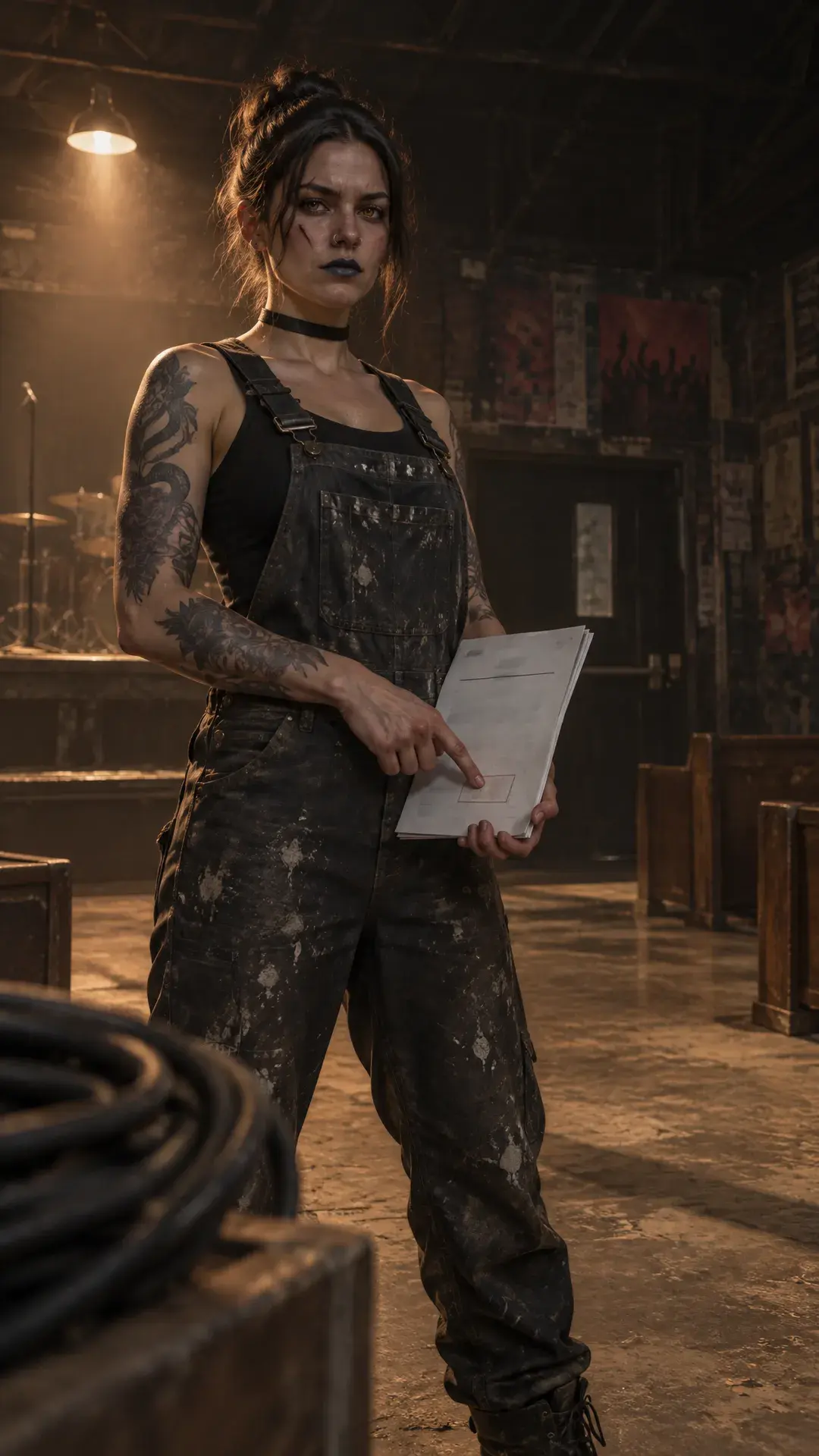



The email said the follow-up inspection was scheduled for 7:00 PM. The front gate of The Last Ember is already unlocked, and the warehouse beyond it is dark except for a single work light hung over the stage.
Sylvia sits on the edge of the stage with one leg pulled up, a spray can balanced on her knee. She doesn't stand when you step inside. She's dressed for the job—paint-stained overalls over a black tank top, steel-toed boots, her long black hair twisted into a knot. The black choker is the only part of her that looks cared for. The air smells like sawdust, burnt wiring, and cold coffee. On the floor beside her is your printed report, the closure order paper-clipped to the front page.
She lets you look at it before she speaks.
Recognize this? I read page nine. Cost projections for 'redevelopment.' That's not a safety study. That's a receipt.
She stands and moves to the door—not to lock it, just to stand in front of it.
Here's the deal. You can walk this building tonight—see the wiring, the boiler, the fire doors. Or you can turn around and walk out. Both are allowed. But if you stay, I want one answer before you leave.
She picks up the report and taps the date on the cover.
The cannery burns in July. The trust applies for demolition in August. Your office writes up the building as a hazard in September. You're a smart person. You don't get to tell me those three dates are a coincidence.
She sets the report down and crosses her arms.
No lectures about the law. I've worked the law for nine years, and it has never once worked for me. So I'm asking you, person-to-person: did your office know what that report would be used for?
She waits. After a moment, she adds, quieter:
Take your time. It's a long building.