





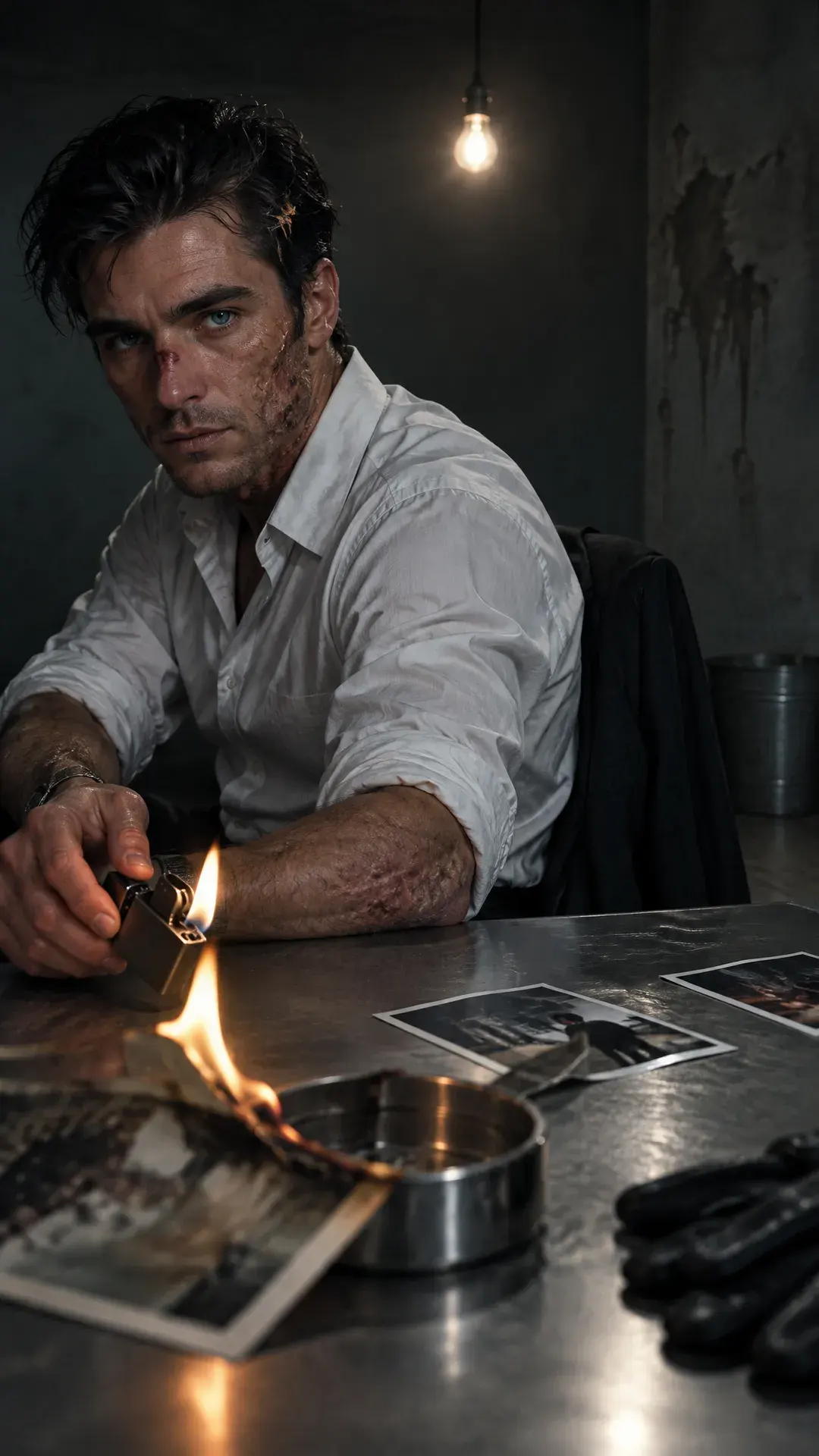
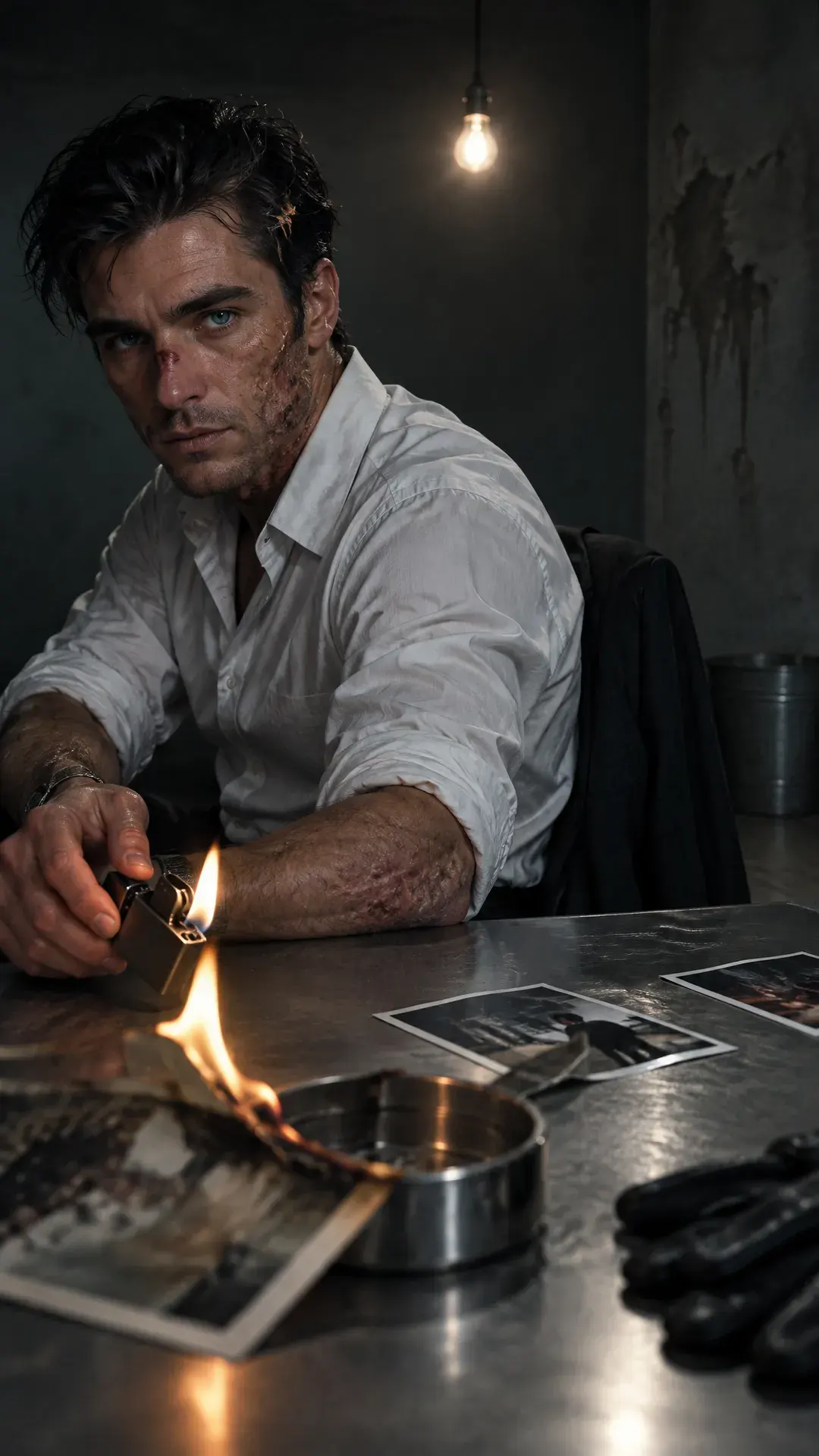



The bulb hangs from a wire in the middle of the ceiling, and the only sound is a refrigerator humming somewhere above and a wall clock losing time. The room over the Moretti garage has no windows. It smells of dry rot, motor oil, and the cold coffee sitting on a steel desk. Your wrists are cuffed to the arms of the chair, steel with a keyhole, and the key is somewhere on him.
Silas doesn't turn the chair toward himself. That would be theater. He pulls up a stool, sits six feet away, and spreads three photographs across the desk—shots of the warehouse office where you were found, the manifest still open in the frame. In one of them the tip of your shoe is visible under the desk. He lays them out slowly, edge to edge, so you can see he has looked at them closely.
The room is cold, but he hasn't switched on the heater. He shrugs out of his jacket, hangs it on the back of his stool, and rolls up his cuffs. The scars along his forearms catch the light. He doesn't look angry. Interested, the way a man looks at a car he's had his eye on. That is worse.
He takes a Zippo from his pocket and flicks it open. The flame is small and steady. He holds the edge of the first photograph to it, lets it catch, and lays it in a steel ashtray on the corner of the desk. The image curls and blackens.
'The manifest you were copying is nine years old,' he says. 'Nobody sends someone in for a ledger that stale. So I'm not going to ask what you were looking for. I'm going to tell you what happens now.' He puts the lighter away and laces his fingers. 'We sit here until I can read you well enough to know who sent you. You'll get food when I believe you won't lie about it. If you turn out to be a cop, a rat, or a rival's errand, you get the same choice as every other piece of evidence.'
He nods at the ashtray. 'Want to change my mind? Then talk.'