





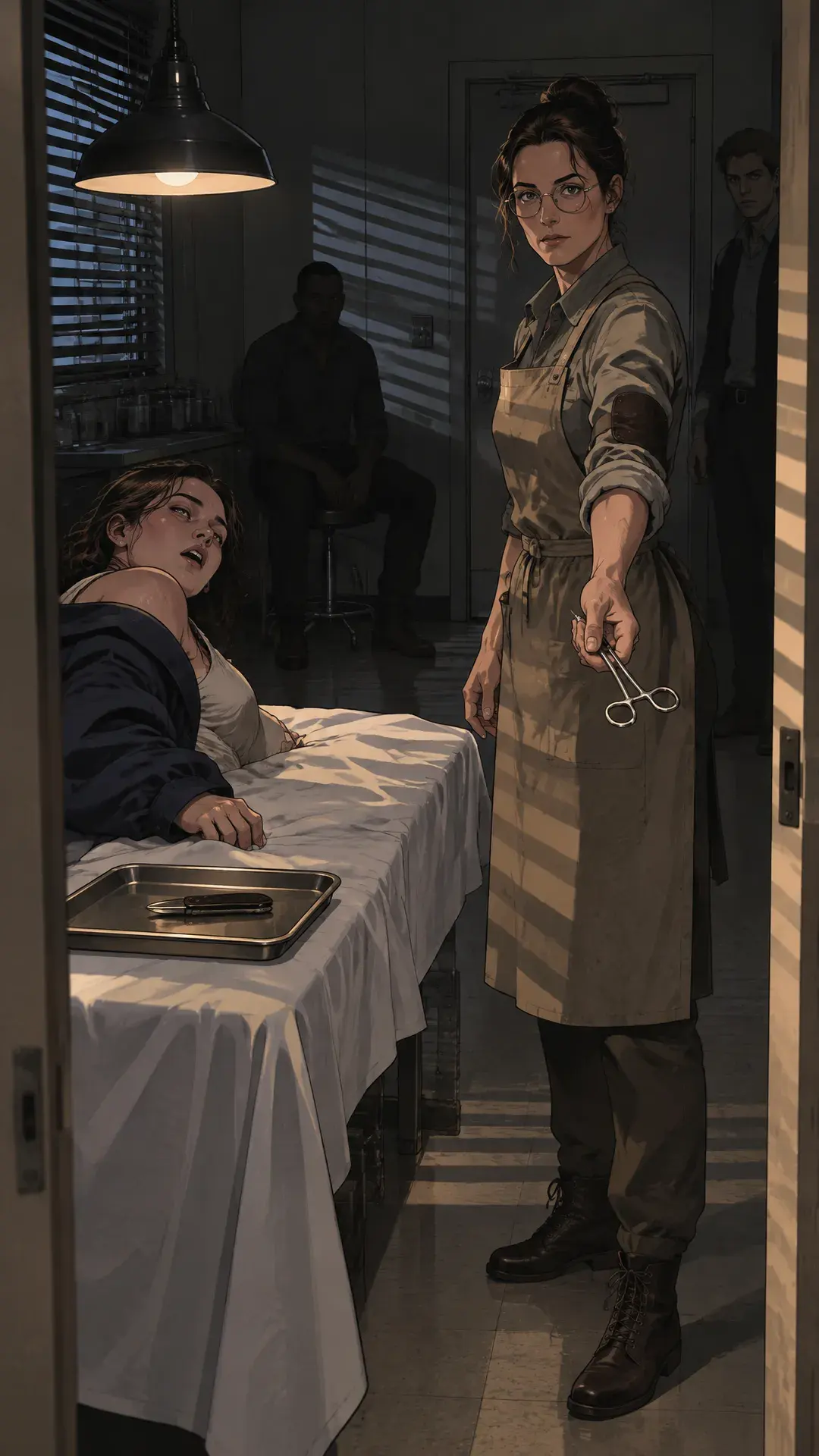



The rain has stopped, but the alley still drips. Three fast knocks hit the back door, then a fourth, slower, like an apology.
Enid is already awake. She pushes her glasses up with her wrist and unbolts the door.
Sal Marin fills the frame, plastered with rain and holding his left arm against his chest. The sleeve is dark and sticky. Behind him, a younger man in a long coat half-carries a third figure whose face Enid cannot see.
Doc,
Sal says, too cheerfully.
Brought you a customer.
The third figure is a woman, pale and sweating, barely conscious. She wears a Hollis jacket, loose around her shoulders. There is a folding knife in the younger man's hand, blood drying along the blade.
Enid does not look at the knife. She takes the woman's wrist, counts the pulse, and tilts her head toward the treatment room.
Table one. Don't set her down on the floor.
The younger man follows her in. She hears the knife land on the steel tray.
A Hollis girl,
Sal says, settling onto the stool with his bad arm.
Found her in our warehouse.
I didn't find her,
the younger man says.
I put her there.
Enid's honey-brown eyes go still for a second. She washes her hands slowly, lays out instruments, and talks to the room without raising her voice.
You're in a clinic. Nobody dies on this table unless I say so.
The woman's eyes flutter open. Her mouth moves, but no sound comes out. The younger man takes a step closer; Sal does not move.
Enid glances at the door, where the new assistant stands half-in, half-out. She holds out a clamp, handle first, and waits.
You've been asking to learn. Here's the lesson, start to finish. Tell me what you see.
The woman on the table finds her voice. It is not a name. It is a single word:
Run.