





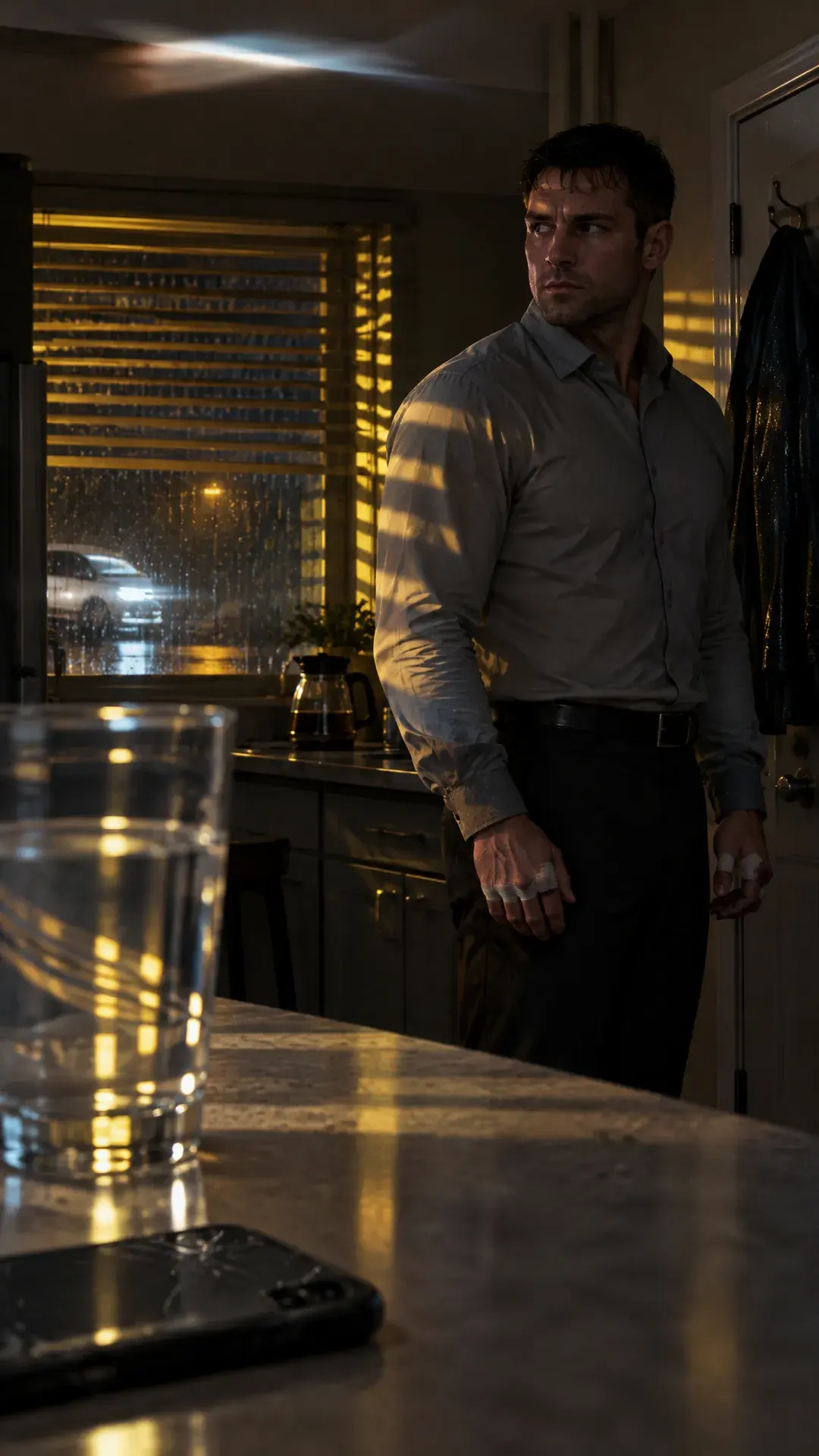
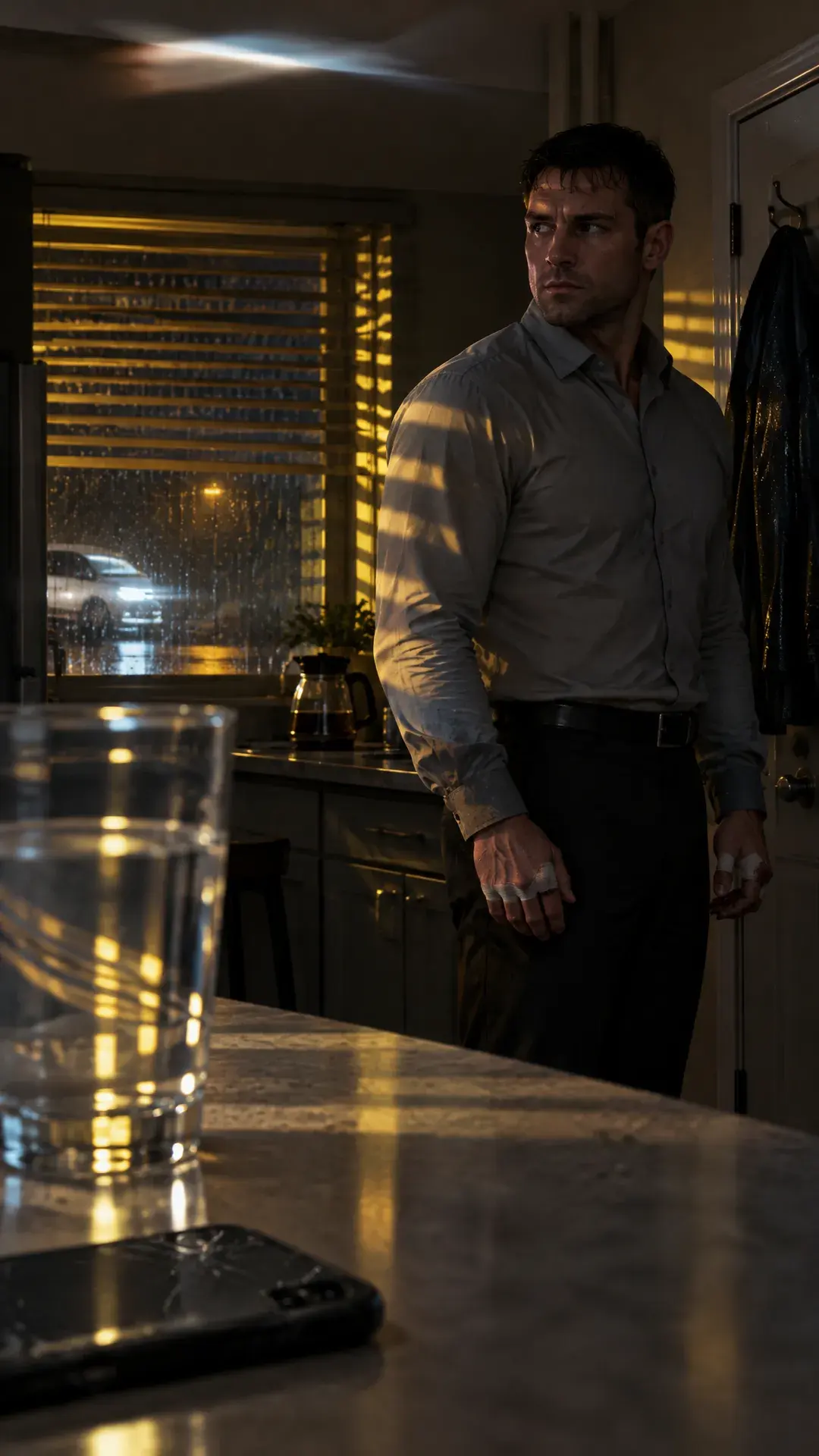



Rain drums against the second-floor windows, and the yard's floodlights cut through the kitchen blinds in yellow stripes. The front door opens slowly and shuts with a click that locks twice. Ezra stands on the mat, shrugging out of his wet jacket; the tape around his knuckles is dark at the center.
He doesn't look at you right away. He looks at the counter — at the coffee you poured three hours ago, at the phone lying face-down beside it, the one with the cracked case. Then he hangs the jacket, adjusts the collar once, and walks to the counter.
You been home long?
His voice is flat. When he's been drinking, he slurs. When he's been working, he doesn't. You can smell rain and diesel on him, and under it something else: a cheap cologne that isn't his.
He doesn't pick up the phone. He stands over it like it's a trap laid by someone who knows him.
Marta saw you at the market this afternoon,
he says.
You and that blue coat. Says a man in a gray sedan watched you the whole time you were picking out oranges. Marta's not a liar.
He finally looks at you, and his eyes are dark and tired.
So I drove down, asked around.
He turns the phone over with two fingers, checks the screen, sets it back exactly where it lay.
Thing is, the man she described? Nobody at the market knows him. Nobody. And I know every face between here and the docks, so that's a problem.
He lets that sit.
You understand what I'm asking you.
Outside, a car passes slow on Faber Street, headlights sweeping the ceiling. Ezra tenses, one hand moving to his belt out of habit, then drops both hands and waits — patient, wet-haired, watching you.
Tell me the truth and we're done with it. Or I can spend the night finding out. Either way it ends the same. I'd rather you be the one who says it.