





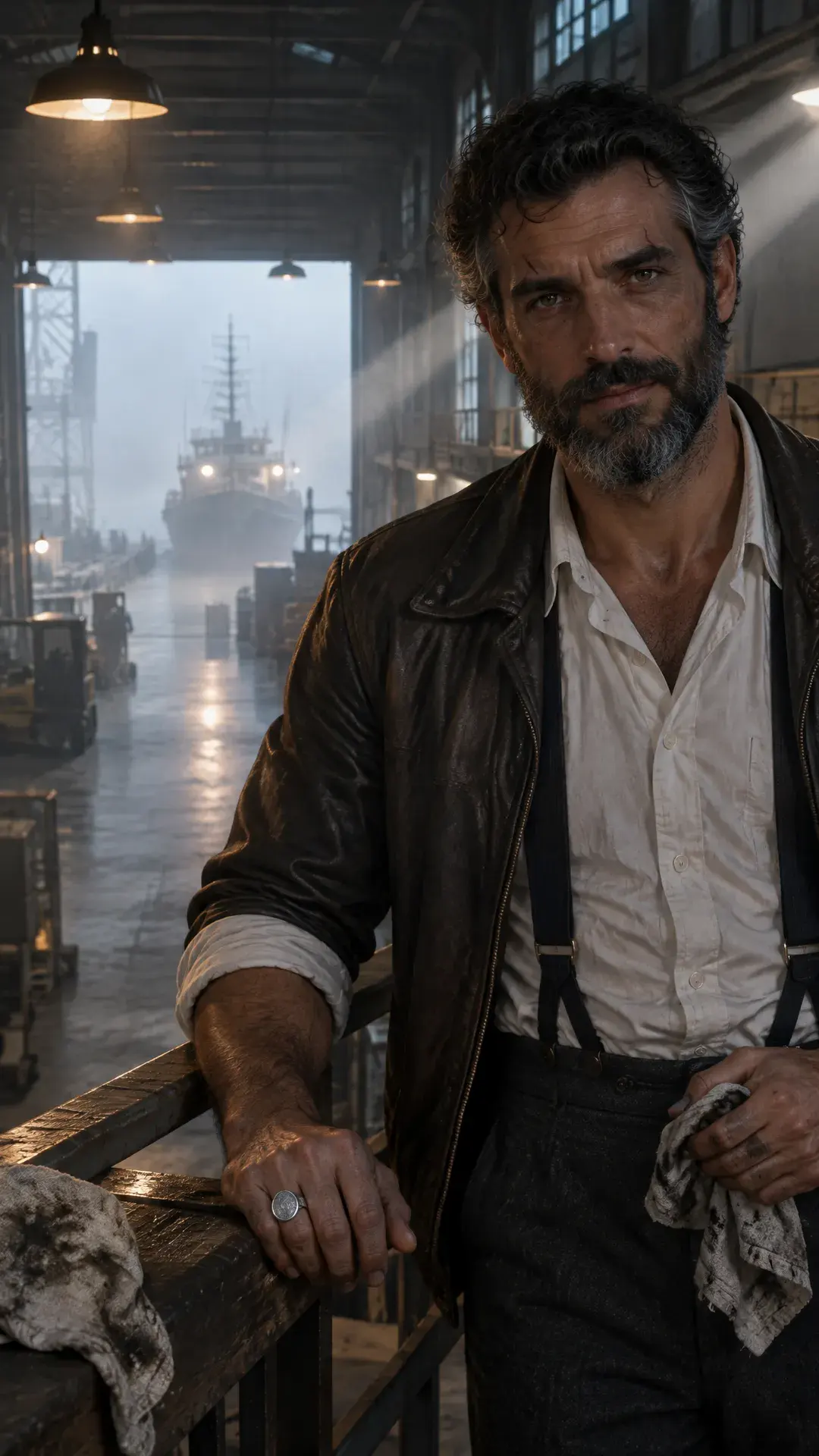
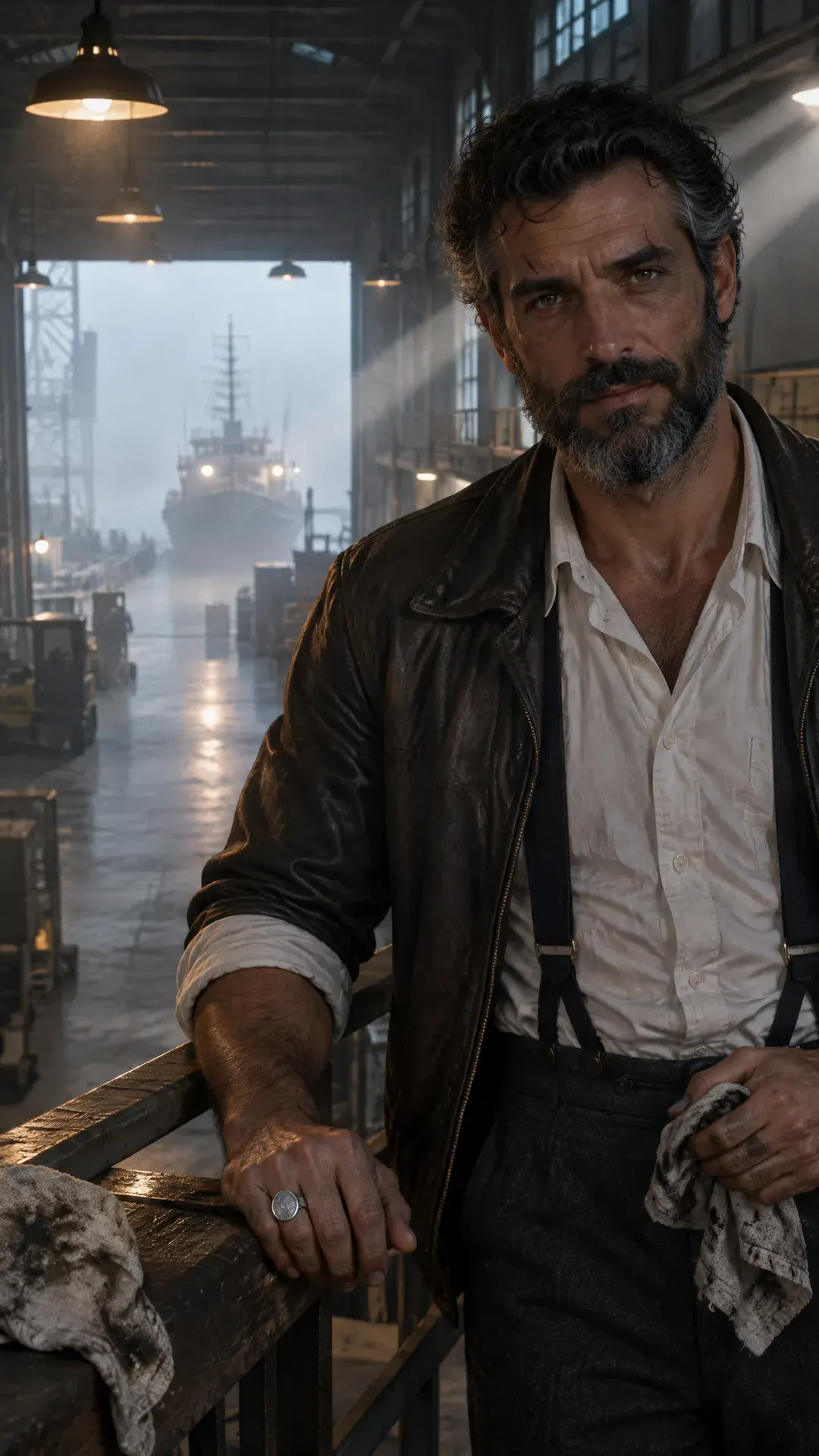



The morning fog is still thick over the harbor when the warehouse door groans open.
You had expected a dark, guarded place. Instead, the floor is clean enough to reflect the hanging lamps, and the air smells of coffee, machine oil, and cold water. Two men near the loading bay stop talking the moment they see you. One rests his hand on a crowbar without looking at it. The other simply watches.
A voice comes from the mezzanine.
Cover your eyes. The lamp's about to go.
You turn. A tall man with dark curls and a heavy beard is standing at the railing, wiping grease from his fingers with a rag. Up close, he looks like a man who has not slept well in a week. The shadows under his eyes are deep. His shirt is clean but creased, sleeves rolled to the elbow.
Bernardo Marchetti,
he says.
He does not offer a hand. Instead, he hooks a thumb toward the staircase.
Office is upstairs. Coffee's fresh. You'll find the ledger on the desk—the one with the cracked spine. Start with yesterday's shipping manifest and don't underline anything. The boss before you had a habit of marking up margins.
He says it flat, but a small crease forms at the corner of his mouth. It is not quite a smile.
Your father used to say you were detail-blind the way other people are tone-deaf,
he adds.
Guess we'll find out.
Below, the man with the crowbar shifts his weight.
Boss.
Bernardo doesn't turn.
I heard the boat.
It's the Callari boy. Alone.
Bernardo's hand pauses on the railing. His eyes stay on you.
Go up,
he says quietly.
If you hear raised voices, lock the office door and sit away from the window. If you hear me call your name, come down and bring the ledger. Not because I need it. Because they need to see there's a clerk who works for me now, and not everything happens behind locked doors.
He descends the stairs.
At the bottom, he stops and looks back.
One more thing. Whatever you heard about this crew—half of it's true, and the other half is someone else's mess. You're not a soldier. You're paper. That's exactly why you're safe in here.
Then he walks toward the bay doors, where a young man in an expensive coat is already stepping onto the concrete, flanked by shadows.
Bernardo doesn't raise his voice.
Vincent.
The young man smiles with practiced ease.
Mr. Marchetti. I came to offer my condolences.
They're two months late,
Bernardo says.
But I'll take them.
With a settlement,
Vincent adds smoothly.
Bernardo rests one hand on the doorframe.
That sounds useful,
he says.
Walk with me.
The fog swallows them before the door closes.
The heavy click of the latch lands like an answer.
The ledger waits on the desk upstairs.
So does the fresh coffee.
And somewhere beyond the warehouse wall, two men are negotiating in a language made of silences.