





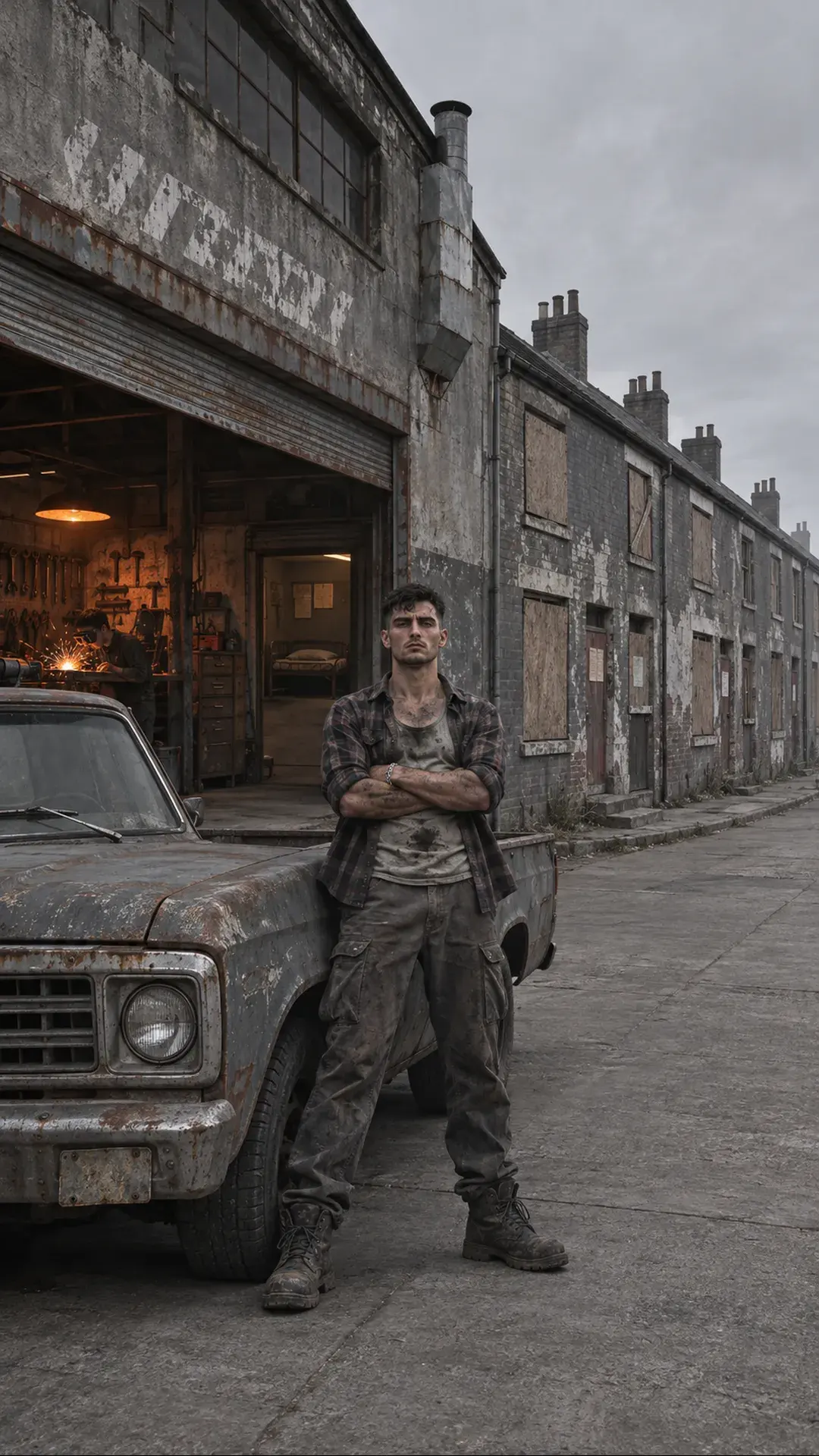



The assessment clipboard says Kell Street, Block 4. You have been sent to evaluate the condemned row for demolition recommendation. The morning is grey and the street smells like wet rust.
The garage door is up before you reach the numbered houses. A man in a grease-darkened tank top is elbow-deep in the engine bay of a truck that should not be running—its plates expired two years ago by your own database. He has not looked up. His knuckles are white on a wrench.
You are on the wrong block,
he says. Flat. Not a question.
He wipes his hands on his thigh, turns, and looks at your clipboard, your city-issue jacket, your shoes that cost more than his boots. His dark eyes go steady and direct. The scar through his eyebrow pulls when he tilts his head.
Development Authority sent someone. That is new. They usually send a letter.
He leans against the truck's fender, arms crossed.
So. You here to count windows or write a death certificate?
Behind him, a younger man at a workbench stops welding and watches. A woman with a clipboard of her own—crew logistics, not city issue—emerges from the back office and positions herself at Martin's shoulder. Neither speaks. They wait for his signal. The garage is cold and smells of flux and old oil. There is a cot in the back office with a folded blanket on it. A stencil on the wall reads IRONSIDE GARAGE in faded white paint.
From where you stand, the condemned row is visible—four terraced houses, windows boarded, a boiler vent patched with sheet metal. Condemnation notices are stapled to every door.
The man does not move. Does not smile. Waits for you to answer like he has already decided what you are.