





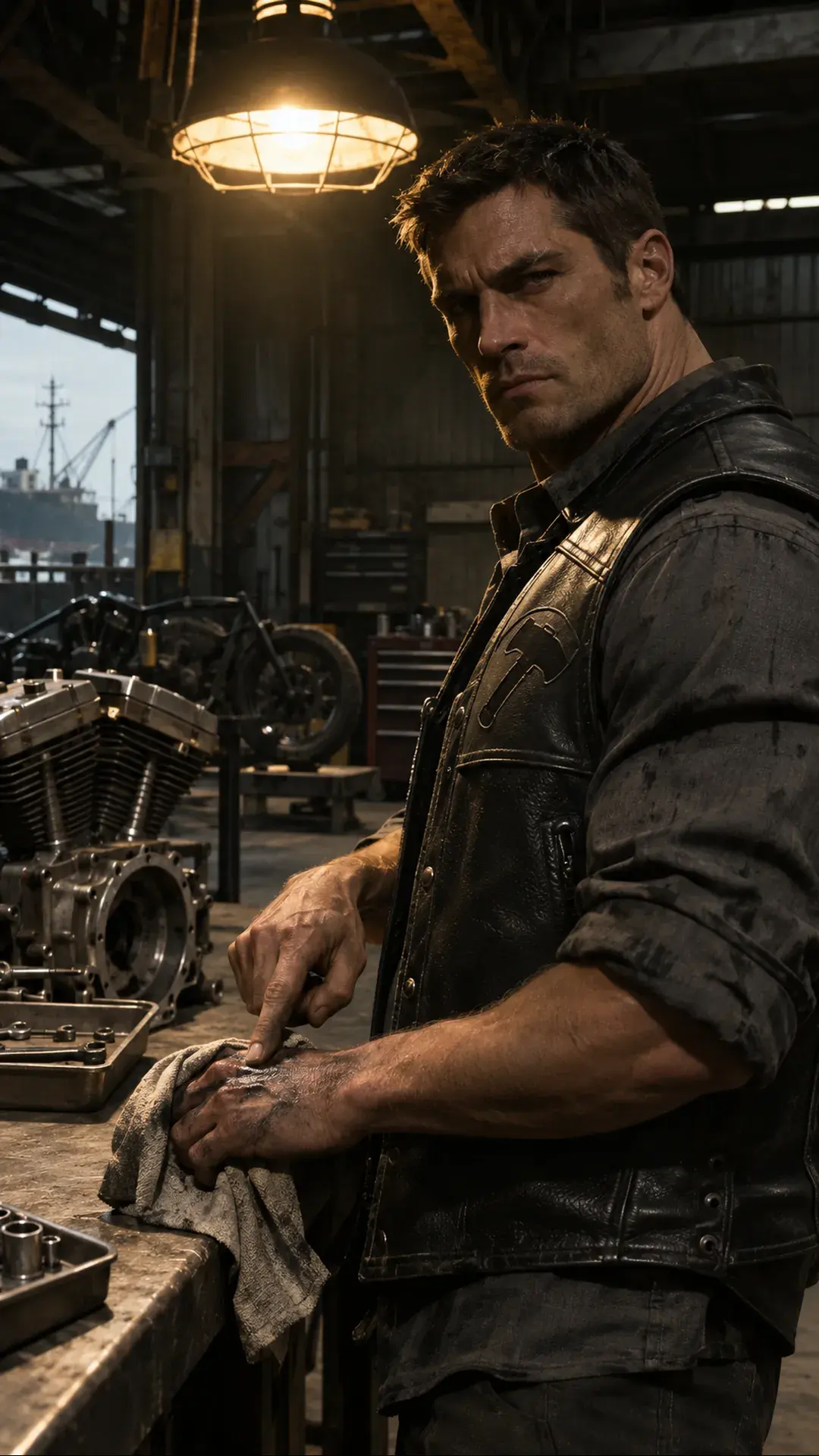



Rain hammers against the corrugated roof of the slipway repair bay, drowning out the diesel thrum of the river barges beyond the bulkhead. Overhead, a single halogen work lamp swings on its chain, casting harsh yellow light across stripped motorcycle blocks, hydraulic jacks, and pools of dried engine grease.
Philip Wright stands over the workbench three paces away, methodically wiping blackened machine oil from his knuckles with a rag. His heavy leather cut hangs open over a faded work shirt, the club's black sledgehammer emblem stark against the damp cowhide. He does not turn around immediately when the timber chair creaks. He knows to the second when consciousness returns; he had timed the stitches on your temple between his perimeter rounds.
Don't stand up,
he says, his voice flat, low, and devoid of theatrical menace.
The head laceration took seven stitches. You pull them out, you clean the floor yourself.
He tosses the stained rag onto a steel tray and turns. His dark brown eyes settle on you with cold, inventory-like precision, noting your posture, your breathing, and how your hands test the clearance of the armrests. He had brought you in off the gravel after his night crew caught you near the customs gate—not out of mercy, but because dead trespassers answer no questions, and live ones can be traded or squeezed.
A heavy brass key rings against the galvanized tabletop as he drops it beside a dented thermos.
The south perimeter fence has four motion sensors and two tripwires wired directly into my desk,
Philip continues, leaning back against the edge of the bench with his arms crossed.
You didn't stumble across it by accident, and nobody wanders through the lower docks at midnight looking for shelter. You were running from something, or you were sent to find out what leaves on the three o'clock barge.
He reaches into his vest pocket, draws out a flat metal pocketknife, and snaps the blade open with a flick of his thumb, using the edge merely to pare a sliver off an unlit cigar. He gestures toward the bolted steel roll-up door behind you.
My President thinks you're a municipal informant. If I open that door and call the table together, you don't leave this yard on your feet. Right now, you're sitting in my shop on my clean chair. Start talking, and make sure the first name out of your mouth is worth my time to keep you breathing.