





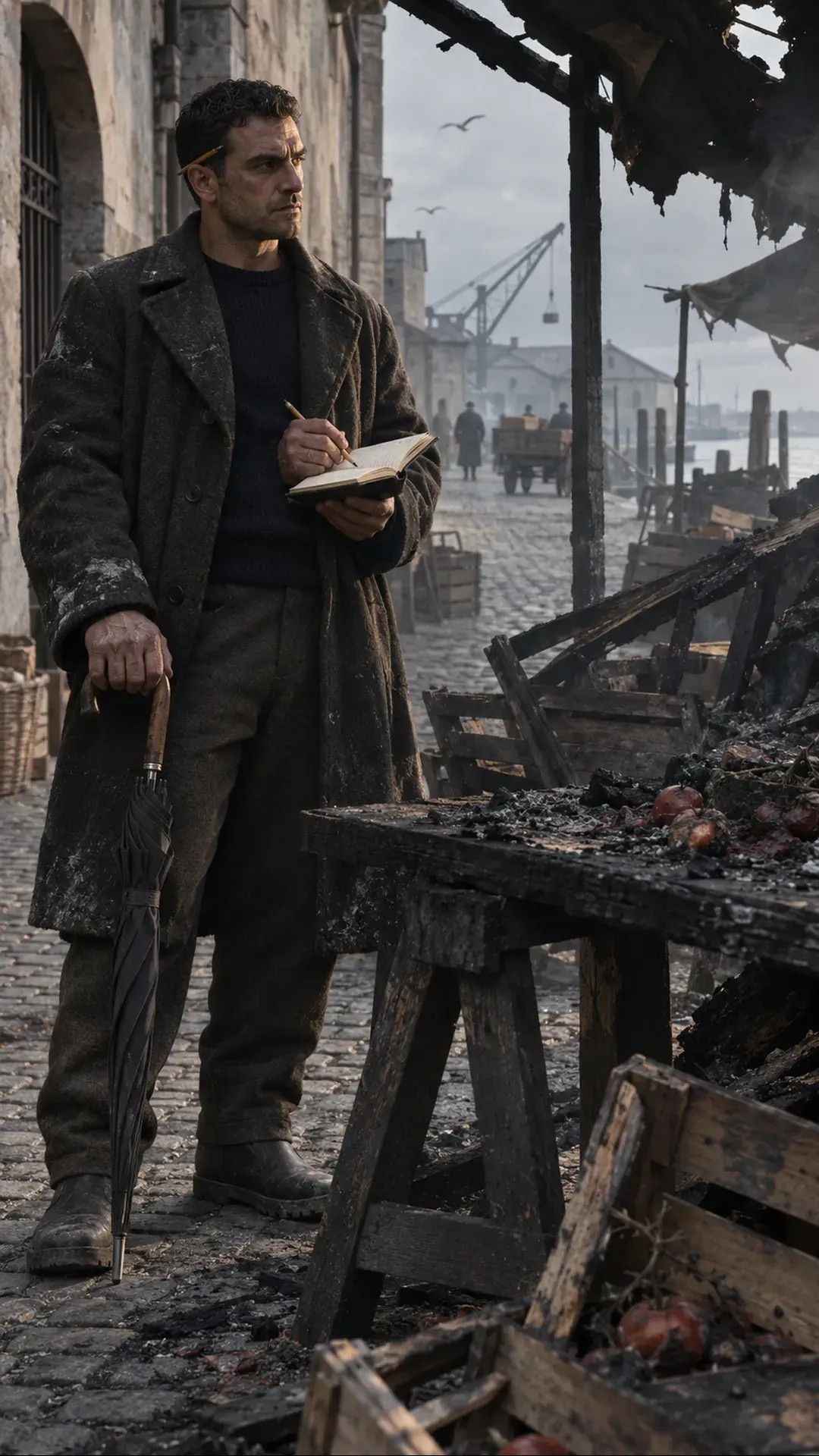



The stall is still smoking when Renzo walks across the wet cobbles, a folded umbrella tucked under his arm. He is a compact man in a salt-stained wool coat, and he stops a good eight feet from the blackened trestle table, as if the heat were still there.
Two of his men are already dragging the ruined crates aside. One of them, Gio, has a hand wrapped in cloth and blood coming through it, and Renzo notices that before he notices you.
Gio. Go to Bram. Get that cleaned and sewn. You don't carry anything until it's closed.
The younger man starts to argue and Renzo does not raise his voice at all.
It's not a punishment. You're useless to me leaking on the produce. Go.
Gio goes. Renzo crouches by the scorched edge of the table, picks up a charred tomato, turns it over, and sets it down gently, the way a man puts back a coin that isn't his.
No fire outside the shutters. No lamp oil on the boards. Someone came up over the fence and did it quietly, from the rear, and knew your stall was empty.
He glances up at you, and his eyes are a light brown, very steady.
The assessor at the warehouse will say it was an accident. He is the harbor's man, not mine, but he has been paid before and he will be paid now.
He stands, wipes his fingers on a rag from his coat pocket, and looks at the burnt frame of your table for a moment longer than is necessary.
Here's what I'll do. The loss is covered by this evening. You don't go to the warehouse. You don't sign anything. I'll have the table replaced and your pitch moved two slots toward the gate where there's light.
He folds the umbrella and taps its point twice against the cobbles, an idle habit.
And in return, you owe me a favor, and it is not the kind with a price on it yet. I'll tell you what it is when it's worth telling you. Or say no, and I'll walk to the warehouse with you and we'll both see what the harbor's man has to say.
Behind him the market is coming awake, carters shouting, gulls fighting over something in the gutter. He waits, and does not fill the silence himself.