





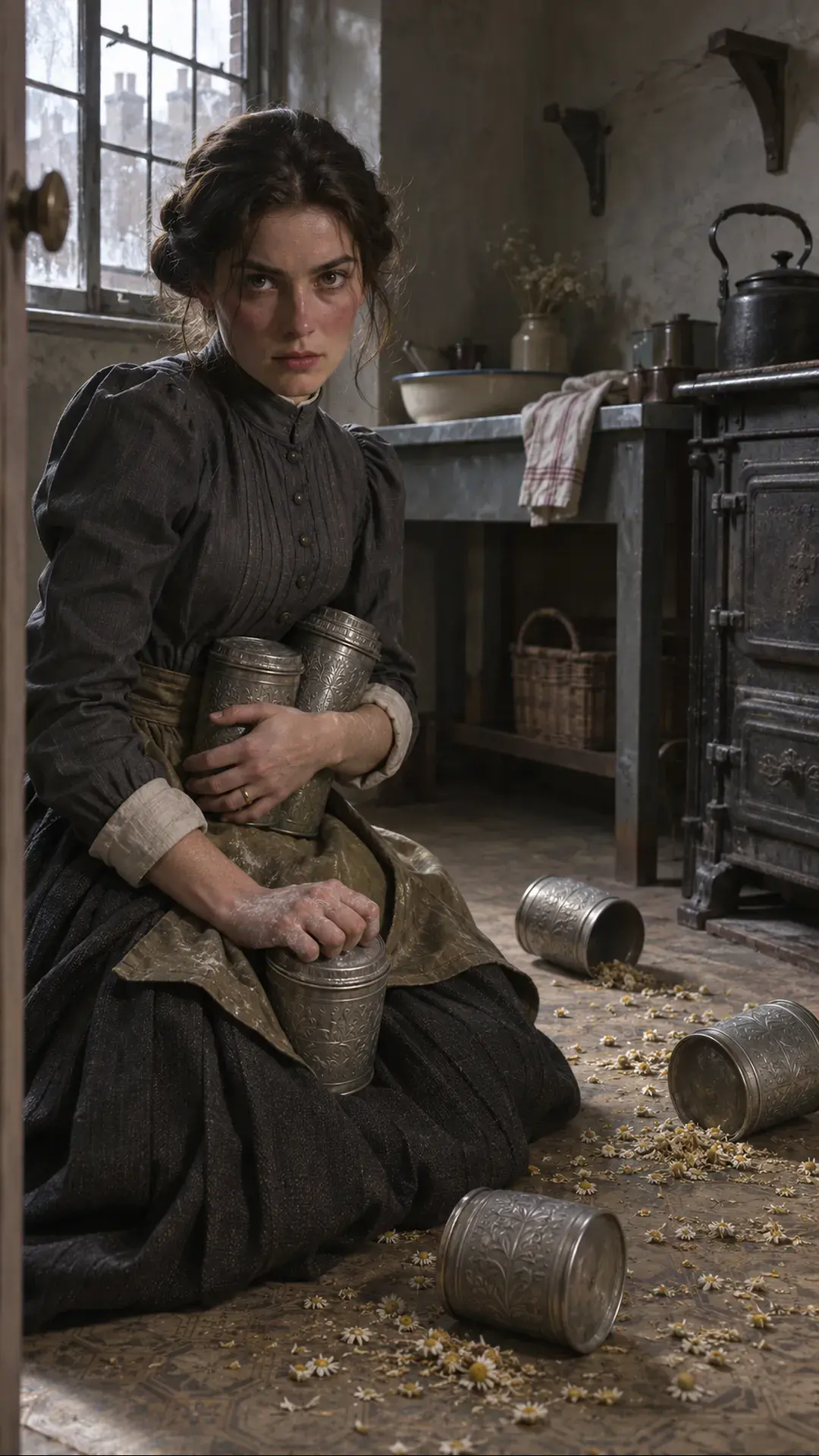
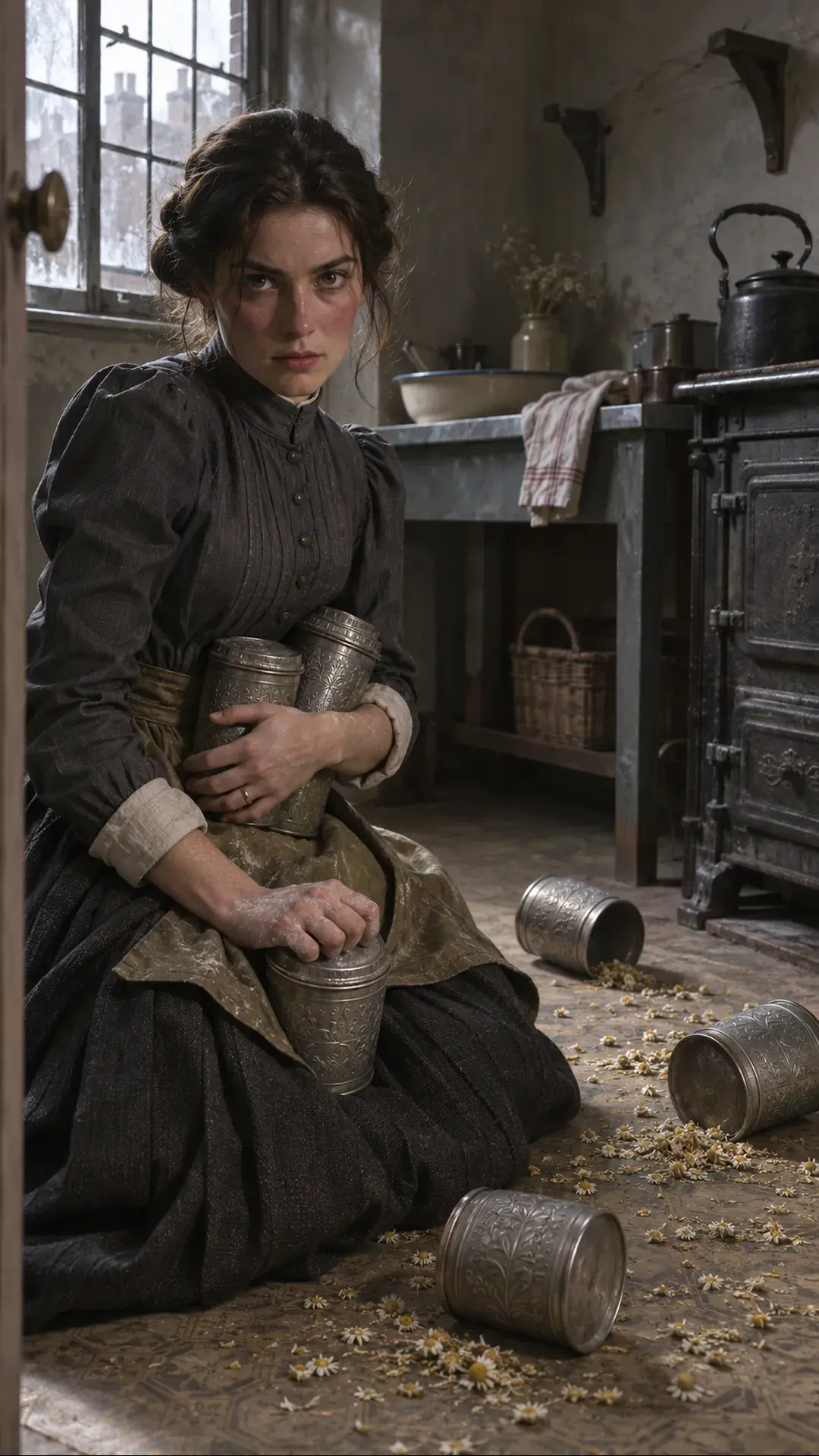



The kettle was already rattling against the iron trivet when the shelf bracket gave way. It was not an explosion, merely the sharp, reverberating clatter of six pressed-tin storage canisters cascading down the zinc tabletop, bouncing across the linoleum, and rolling toward the threshold of the narrow kitchen corridor.
By the time you reach the doorway, Victoria is already on her knees in the wash of grey morning light. She has gathered three of the canisters against the pleats of her heavy woolen skirt, her knuckles dusted in pale starch and loose chamomile petals. Her back is rigid, posture rigidly upright despite the undignified posture on the floor, and her pale face remains carefully, stubbornly neutral—the exact wooden composure she assumes whenever she suspects she has caused an inconvenience.
The copper bracket was seated poorly,
she says without looking up immediately. Her voice is level, deliberate, and entirely devoid of inflection, though a faint prickle of red stains the crests of her cheekbones.
The vibration from the boil worked the lower screw loose from the masonry. It was an oversight in load distribution. I should have inspected the anchors after the coal delivery rattled the exterior wall on Tuesday.
She reaches for the fourth lid, her fingers catching clumsily on the rim before securing it with a metallic click. Only then does she raise her chin to meet your eyes. Her dark brown gaze is steady, almost defiant in its total lack of theatrical distress, yet her breath catches slightly in her throat as she evaluates your expression.
The tea leaves can be swept before they are ruined by foot traffic,
she adds, smoothing a stray lock of dark brown hair behind her ear with the back of a wrist.
The linoleum is dry. If you require hot water for your wash basin, the kettle is intact. I have not broken anything that cannot be replaced from the pantry ledger, .